EXPLORING THE COLORS
Homage to Luciano Berio
A program conceived in 2025, the centenary of Luciano Berio’s birth, to pay homage to the great composer. The music program is composed by the Sequenza VIIb for soprano saxophone and Sequenza IXb for alto saxophone, a re-evocation of Bach’s Art of Fugue through the reinterpretations of Luis De Pablo, which recur cyclically throughout the concert, and Piangere la pietra – III Studio sul Disoriente by Fernando Mencherini with the pre-recorded voice of poet Edoardo Sanguineti, another evocative dialogue in which the soundscape is in constant metamorphosis.
ANTITHESIS
One of the most significant compositional trends developed in the second half of the xx century is the effort to enhance the level of listening perception. Sounds have been given elaborate attention in the guise of scientific research. This tendency has opened a new and demanding frontier in music in which the notations for the dynamics in the scores have suddenly become futile compared to the depth of the sound research and the unusual techniques. The contemporary music system has commenced an unorthodox revolt scrutinizing the details surrounding the inaudible as well as those around the full intensity of the sound. This kind of research spans from the silent detail of the famous Scelsi piano key with the pedal until the ending of the sonic matter to the recent saturationist excursions found in French composers. One might ask if it is possible for the research and the techniques to blend so as to create a new contemporary panorama. Can scanning the dynamics and the extreme areas be a way of being transported into an emotional cell which is stimulated by the instruments? Is it possible to create a new sensitivity? And, if so, what kind of dialectic would emerge from the game of forces?
The selection that Bianchini proposes might be the answer to these questions. Here the compositions converge towards an idea of flow regulation, extensions and techniques that work together to catch what happens within a sound in a specific time. The saxophone is chosen for its corporeal sound offering an instrumental excellence that allows to live the ‘matter’ dimension. Everything that hands, mouth, fingerings, or breath carve is unity, a tangible tension that brings us closer to the physics of the materials as well as the abstraction of art. The corporeality is to be embedded in what Bianchini wished to explore, namely the transparency and the intensity of timbres, currently seen as problematic universes. This corporeality expresses itself in a variety of compositional styles though united by the thread of a definitive semantic change. This work tackles the predictable harmonic sequences as they have been known in classical music until now, because the tension lives in confused situations, in the definitely unconventional textures of the saxophones and in the gestures of the performer. […][…] Bianchini behaves as a conductor of energy, no matter what type, interpretative realism of an explorer of sounds, adamantine or explosive to occurrences, mysterious or granite depending on the type of reflection required by the composition. The dialectic of αντίθεση-antithesis requires the ability to know how to dominate contrasts and it demands a musician capable of creating a range of congruences that are not easily manageable. Ultimately, the entire project of Bianchini is a domination of the objective world liberating a perfectly totalized sound world.
Ettore Garzia
Cover image by Fabio Mariacci – “Pentagramma giallo” di Fabio Mariacci
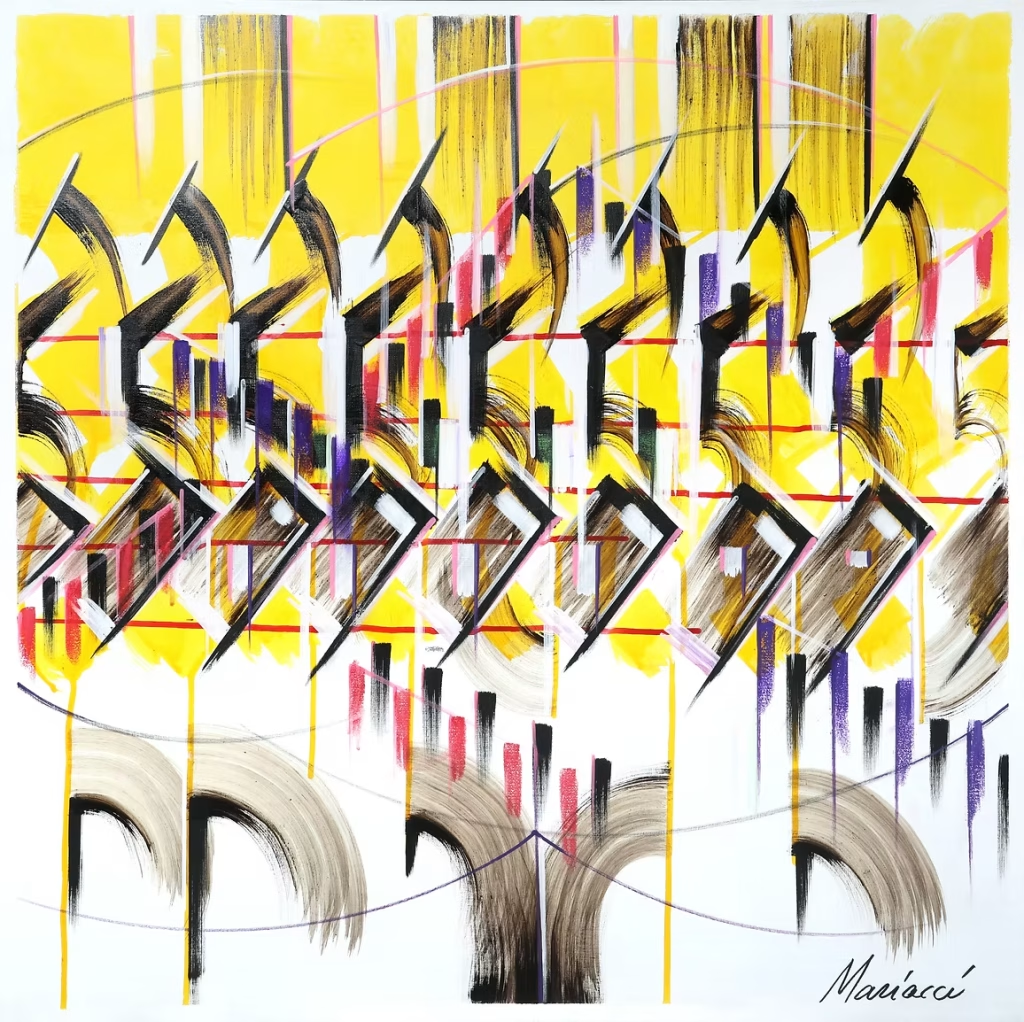
Mariacci’s path toward abstraction blossomed decisively in the 1990s. Endowed with chromatic vitality, his painting—originally constructed through signs—brings together colors on the canvas according to a rigorous rhythmic logic. This is a mode that the artist has recently been revisiting—after a long phase of research centered on concrete forms and flat colors—in which, however, the innovative element compared to the past is the use of bituminous material, still applied in the mode of sign-color, playing on its nuances and on pigments of lighter tones.The result is an expressive inquiry that, compared to earlier works, becomes in certain respects more engaged with the human condition; the “temperature” of the work turns warmer. This new trajectory was set in motion over just a few months, also prompted by the fateful encounter with fire which, while destroying a large part of the artist’s production in an accidental blaze, on the other hand provided a further stimulus to open up toward a pictorial mode that Mariacci had not previously considered. He has not, however, renounced his abstract identity; rather, he has materially reinterpreted his own language.
Lorenzo Fiorucci
Info: fabiomariacci@hotmail.it
CONTRASTI
Contrasts refers to two opposing concepts embedded in 21st-century musical thought and used primarily to describe the qualities of timbre: transparency and intensity. Two microcosms: the pianissimo at the threshold of the inaudible and its dialectic with the most piercing, metallic fortissimo—a concert of timbres and colors. The sonic variety of the pieces leads us to perceive states of calm or anxiety, vocal and instrumental sounds, clearly defined and blurred rhythmic situations, bright and dark timbres, dense or transparent textures. The works are variable while preserving the integrity of the program’s concept.
Below are some excerpts from a live concert at Taverna Maderna, Padua.